
Economy of Words
In the right order, words are money.
Every economy runs on words. A dollar is a promise. A contract is an agreement you signed. A brand is a name you decided to trust.
You cannot own a word. But words in the right order change the world. No one can copyright “zoo” or buy the rights to “love.” Words are the one material everyone already has, free and endless. A commons.
Some words do not describe the world, they change it. “I do.” “Guilty.” “I promise to pay.” Said by the right person, in the right sequence, they move money and bind lives.
And ordering them well is a kind of power. Say the thing right and you can create value, sell it, build something, change a mind, help someone. The words cost nothing. What you do with them is everything.
Order is one thing. Meaning is another. The grade fixes what a word is worth to the rules. It says nothing about what a word is worth to you.
Somewhere there is one person for whom a word is not a word. It is their name, their kid, their hometown, the thing they cannot stop thinking about. To them it is priceless. To everyone else it is a dollar.
It is why this takes the form of a graded card. A card is the one object that carries both numbers at once. The grade is stamped on the slab, fixed, the same in every hand. What it is worth to you is not. Cards have always run on that split: the grade says mint, the bid says it is the one you grew up wanting.
From the outside it looks irrational. A grown person paying for a word. From the inside it is the most logical thing in the world. You are not buying the word, you are buying what it holds: a memory, a name, the version of you it belongs to. Nostalgia is not a flaw in the market. It is the market.
That gap is the auction. The market does not price the word. It finds its person.
Words have never been cheaper. Machines write them by the billion, for free. A word drawn by hand, once, is the rare one. What you are buying is its significance, or the lack of it.
Every card is graded, the way you would grade a rare one. But nothing here is worn. The rarity is not in the condition. It is in the word.
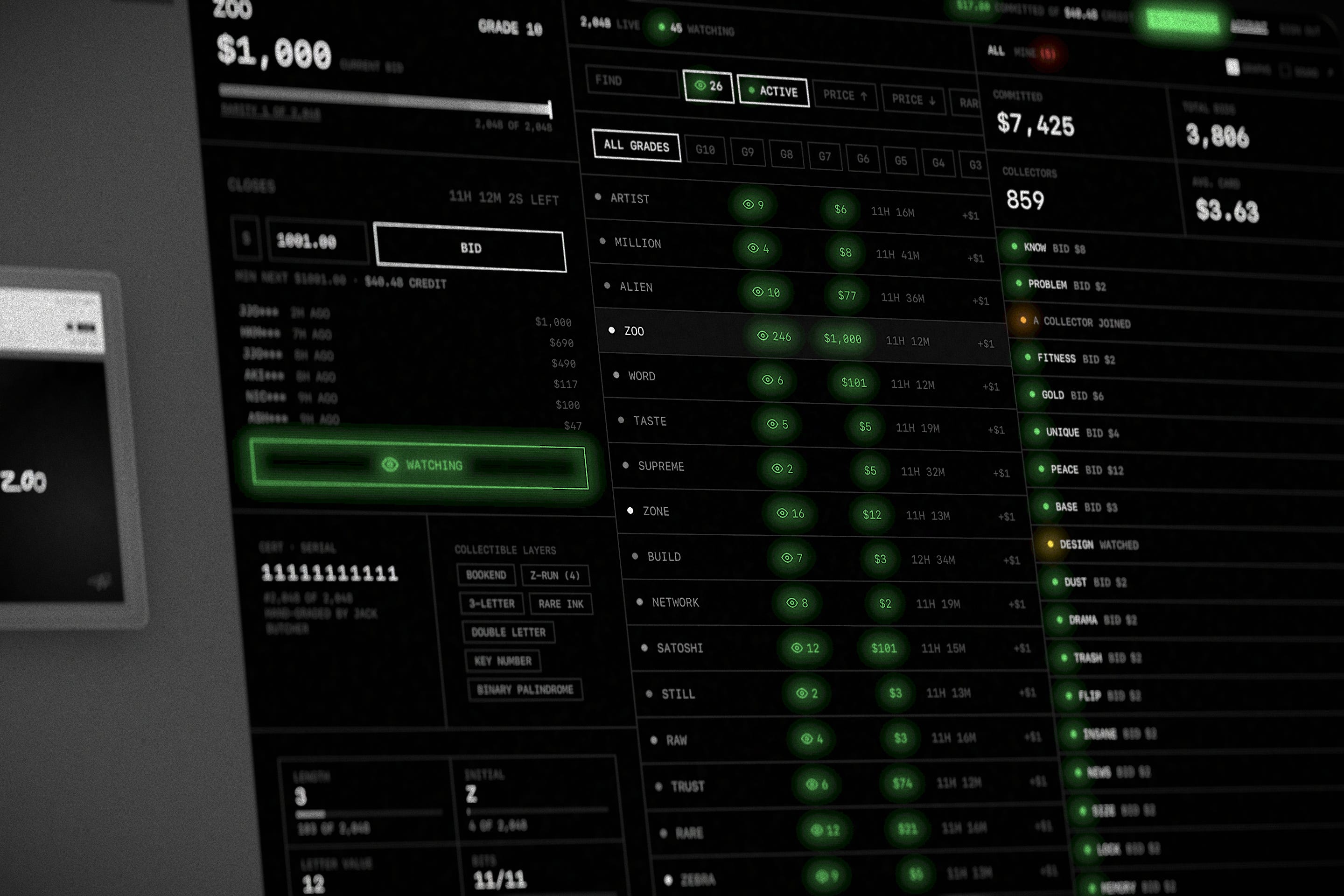
Set by math, not taste: length, first letter, letter value, the number underneath. Run the rules and ZOO is the rarest of all 2,048. Rare for what it is, not how it aged. The full system is below.
Every word opened at a dollar. The rarest and the most common start at the same price, and the market settles the rest.
The grade tells you what is rare. The bids tell you what is loved. They may or may not be the same word. That gap is the piece: a live market for what a word is worth, and no one knows the answer until it closes.
Each lot is its own auction, the clock starts when someone wants it, and you only pay if you win.
Economy of Words uses a fixed list of 2,048 words that secure most of the digital money on earth. It is called BIP39. Twenty-four of them, in the right order, are the key to a wallet. The same twenty-four out of order are nothing.
For years @visualizevalue has made one argument: ideas have value, and the work is making it visible.
Bidding is live for 3 more hours at http://economyofwords.com
An extraordinarily refined idea, the polish of your execution escalates continuously.